
Dave has cockroach genes
2 February 2018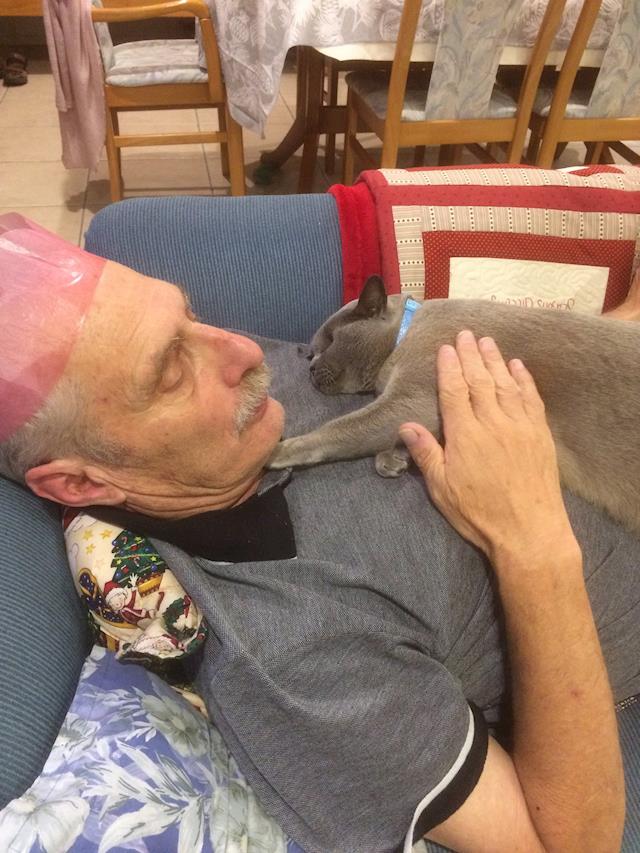
Dave – the cockroach.
My oncologist described NET cancer as “cancer in slow motion” – slow to develop and slow to respond, but it’s a killer and very debilitating during the journey.
I have now received 3 of the 4 planned rounds of PRRT. Last week I had a session with my local (Auckland) specialist and it appears that everything is proceeding according to plan. I feel more energetic (less sleeping in front of the TV at night), and less pain. The scans show a reduction in the size of the cancer and what appears to be a breakup of the large cancer into smaller nodules. For the technically inclined, my cancer has a Ki 67 score of 8%. This means that at any time only 8% of the cancer cells are duplicating. The PRRT particularly attacks the reproducing cells, which explains why they schedule multiple treatments 8 weeks apart. The first treatment knocks out 8 %, the next another 8% of the 92% and 8% for each subsequent treatment. This is not a cure but is a long term palliative. In medical speak they claim a median of 48 months “progression free survival”. This means that they expect 48 months before the cancer starts to wake up and start growing again, and if it does I can come back for further treatments to put it back in its cage. As an optimist I expect to be on the right hand side of the bell curve and look forward to a greater PFS period. By the time it becomes a problem we hope that funding will be available for treatment in New Zealand.
Tanya thinks I have cockroach genes which enable me to survive all the various surgeries, weedkiller rounds, radiation and now PRRT. All have been unpleasant. Some have been painful, some debilitating for long periods, lots of side effects, but I keep coming back.
Once again thanks for your support – without your help this would not have been possible. Much of my treatment to date has been outside the bounds of the public health system (and also my insurance which turned out to be useless as it only provided the same services as the public health system), and our funds have become depleted. Without your help we probably would not have made the decision to undertake PRRT.
One more treatment to go, in early March. This will be followed with an ongoing monitoring plan involving more scans which while available in NZ, are also not publicly funded.
Dave
PRRT
What is peptide receptor radionuclide therapy (PRRT) and how does it work?
Peptide receptor radionuclide therapy (PRRT) is a molecular therapy (also called radioisotope therapy) used to treat a specific type of cancer called neuroendocrine carcinoma or NETs (neuroendocrine tumors). PRRT is also currently being investigated as a treatment for prostate and pancreatic tumors.
In PRRT, a cell-targeting protein (or peptide) called octreotide is combined with a small amount of radioactive material, or radionuclide, creating a special type of radiopharmaceutical called a radiopeptide. When injected into the patient’s bloodstream, this radiopeptide travels to and binds to neuroendocrine tumor cells, delivering a high dose of radiation to the cancer.
The cells in most neuroendocrine tumors have an abundance (called an overexpression) of a specific type of surface receptor—a protein that extends from the cell’s surface—that binds to a hormone in the body called somatostatin. Octreotide is a laboratory-made version of this hormone that binds to somatostatin receptors on neuroendocrine tumors. In PRRT, octreotide is combined with a therapeutic dose of the radionuclides. Yttrium 90 (Y-90) and Lutetium 177 (Lu-177) are the most commonly used radionuclides.