
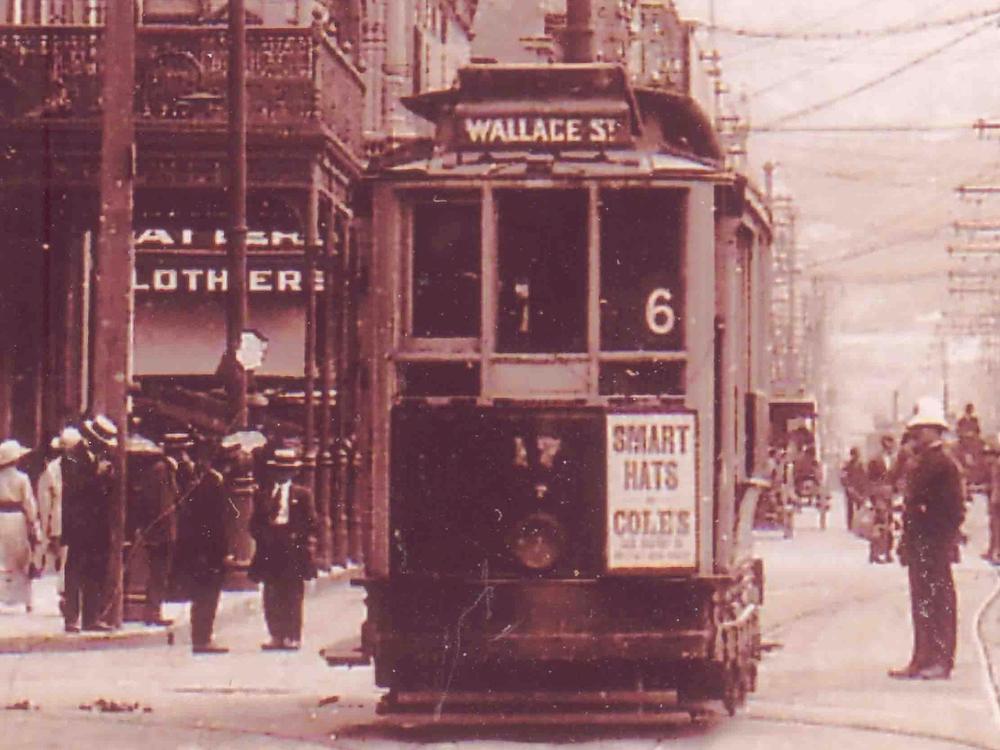
RESTORE AND OPERATE ORIGINAL 1904 EX WELLINGTON ELECTRIC TRAMCAR NO.17
HELP BRING WELLINGTON'S HISTORY BACK TO LIFE! FULL RESTORATION OF TRAM 17, FROM 1904, IS UNDERWAY. YOUR ASSISTANCE WILL HELP ITS COMPLETION
Wellington
Picture a main street scene in any major New Zealand city one hundred years ago. There would be colonial era buildings, a few early cars, horse drawn transport, and as likely as not tram lines with one or more electric trams in view.
Electric trams came to New Zealand around the turn of the twentieth century – Wellington in 1904 – and enabled the rapid growth of suburbs surrounding the cities which until that time had largely been confined to areas within walking distance of the city centre.
In Wellington, by 1915, electric trams extended outwards from the city centre to Newtown, Oriental Bay, Island bay, Lyall Bay, Miramar, Seatoun, Brooklyn, Wadestown, Karori and Northland. Until the arrival of the tramway some of these areas were mainly farming but there was rapid sub-division and suburb development.
Wellington’s trams were a vital part of the city’s infrastructure until well after the Second World War but in the later years both trolley and petrol or diesel buses provided practical alternatives. This, combined with the back-log of maintenance arising from the Second World War period, saw the Wellington City Council make a final decision to abandon trams in favour of buses in 1955. The last tram ran in 1964. At that time a group of volunteers formed the Wellington Tramway Museum with the stated aim of preserving representatives of the electric trams in operating condition. Seven later model trams were preserved and are currently at the Wellington Tramway Museum’s Kapiti Coast Electric Tramway at Paekakariki, north of Wellington.
TRAM NO.17
When Wellington’s electric tramways commenced business in 1904 it was with thirty-three trams imported from England. All of these early trams were withdrawn from service and scrapped by the mid 1950’s. A few survived for a time in use for various purposes on farms etc. In 1986 the Wellington Tramway Museum procured tram No.17 from a property in Raumati South, Kapiti, where it had been in use as a bach for over forty years since its withdrawal from use in 1945. It was placed into covered storage at the Wellington Tramway Museum.
No.17 had been built in England as a fairly small four-wheeled “saloon” type tram and imported and assembled at Newtown depot in Wellington in 1904. With the exponential growth in passenger demand it was, along with seven other similar trams, extended in length at Newtown depot with the addition of an open-sided area at one end of the saloon. No.17, along with the others, was provided with a new, longer, steel chassis and with swivel bogies, or “trucks”, as they are commonly termed. In this guise it re-entered service and gave a good account of itself over all of the wellington tramway system for a further thirty-four years.
CONSERVATION AND PRESERVATION
In 2007 a comprehensive conservation plan for tram 17 was completed and the museum made the decision to commence fund raising for its restoration. It is to be returned to its condition as it was in the late 1930’s – early 40’s with the open portion plus the closed saloon, and the swivel bogies.
Tram 17 has features from the early 1900’s that are not present in the later trams. It has a clerestory roof, ornate fittings and decorative features. It will be amazing to have this tram restored and complete at the Kapiti Coast Electric Tramway.
WORK UNDERWAY
To date over $450,000 has been raised. This covers work on the conservation of the body and chassis which is already being carried out to meticulous standards under contract by The Wheelwright Shop at Gladstone in the Wairarapa. The amount raised also covers the design and procurement of parts for the under-gear, bogies, motors and control gear.
To rebuild and have this tram running again requires a further $200,000. This will enable the engineering work to rebuild the under-gear, bogies, motors and control equipment.
Apart from no.17 none of Wellington’s original trams have been saved. Help us ensure that this early example of the wellington city streetscape of the early 1900’s is preserved for us and future generations to enjoy and appreciate.
Wellington Tramway Museum Incorporated's involvement (page creator)
The Wellington Tramway Museum Incorprated is a volunteer led and operated society that owns and operates the Kapiti Coast Electric Tramway and Museum at Paekakariki, Kapiti, about 50kms north of Wellington. Tram 17 is destined to become a key exhibit at the Museum.
About us
We are a volunteer organisation started in 1964 with seven ex Wellington city electric trams which we have preserved plus much other tramway museum display material. We have built a 2km tramline - the Kapiti Coast Electric Tramway - at Queen Elizabeth Park, MacKays Crossing, Paekakariki. Our museum is open and we operate the trams every weekend and daily during most school holidays.
Other page links
Latest update
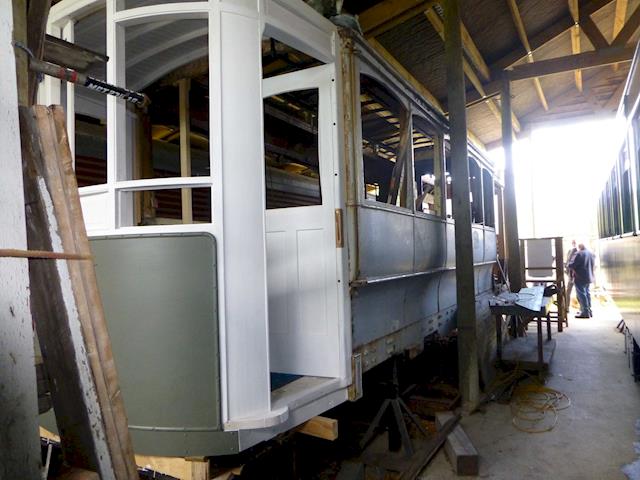
Restroration of the tram body is progressing well 1 October 2015
Photograph shows a general view of restoration underway at The Wheelwright Shop, Gladstone, Wairarapa, June 2015

Latest donations


Who's involved?
Page Q&A
Ask a question hereAny concerns?
Report this pageThank the donor
Your message will be displayed on the page and emailed to the donor.
Your new message will also be emailed to the donor.
Saving a blank entry will delete the current comment.