
Help the Homeless Animals of Chile
For 3 months I traveled Chile to volunteer with local organisations helping animals. In October 2015 I will return to Chile to help more!
Wellington
In October 2015 I will travel again to Chile to help the abandoned animals through sterilization, food, medical attention and treatment and I will be meeting with more government officials to discuss the magnitude of the problem and what they should be doing to help. I will be bringing back the poodles rescued from the Antofagasta landfill in Chile to NZ And this time I am bringing my best friend Graham Hewson with me.
Volunteering as a Veterianary Nurse during my 3 months in Chile, I knew that I was going to see a lot of abuse and neglect but nothing could have prepared me for the horrific things I have seen. The problem is worse than I could have ever imagined in Chile and is treated as a cultural norm by most of the people. There are WELL OVER 3 million street dogs in Chile. From what I have seen I think the number of street dogs and the neglect is a reflection of a culture which sees the dogs as objects and not living creatures, little to no support from the government to help the situation, no real media attention and no education to teach people about how to care for animals or why sterilization is important. In every city I have visited in Chile I have noticed a culture of the people which does not understand the importance of sterilization or responsible ownership. Because of this trend many people refuse to sterilize their animals and let them roam the streets to reproduce, then when the puppies are born they abandon them or even worse kill them. The key to addressing this is EDUCATION! Children in schools should be taught about animal ownership and there should be campaigns on every television channel explaining the importance of sterilization and where they can go to have their animal sterilized for free. People need to understand that one female dog and her offspring can potentially produce 66,000 dogs in just 6 years. In Puerto Montt we hired a community hall for one day where a Veterinarian and I sterilized over 60 dogs and 20 cats in just one day, we worked all day until late at night in terrible unhygienic conditions, but with limited resources and money we had no other choice.
Every day of this trip, I met with officials in local governments (and the main government), appeared on live television, featured in over 5 newspapers and appeared live on 2 different radio networks. I worked at refuges, treated dogs on the street for mange and parasites and injuries, visited landfills, operated in surgeries to sterilize animals, arranged mass street protests and met with so many people. I had hoped to meet the president but I received a letter from her saying that she would not meet with me sadly. I have not given up hope of one day meeting her though.
Before I arrived the President announced a new law allowing dogs to be shot dead if they were 400 metres out of a city. What kind of message is this meant to send to the people about the government´s stance on animal welfare???? In every city I went to I attended mass street protests and demonstrations and I met with officials to talk to them about this law. I am very pleased to announce that the government has now announced that this law is now on ´hold´ and likely to be cancelled.
There are many small groups of people which work hard to feed and sterilize the animals but there are too many dogs for these volunteers to help. The other day I was in a small town called Limache and I stayed at a refuge for abused dogs and farm animals (including horses, donkeys, goats, llamas, pigs, chickens, etc), this refuge cannot afford to feed all the animals they have. We had to wait until the local fruit and vegetable market finished and then we went down there in a ute and on our hands and knees we picked up all the rotting vegetables on the ground that we could find so we could feed the animals that day. At this market I saw dogs in the worst condition I have ever seen, they were not even recognisable as dogs at first, they were so emaciated and bald and swollen from the mange and parasites but this group was struggling to even feed the animals it already had and did not have the resources to help any more animals.
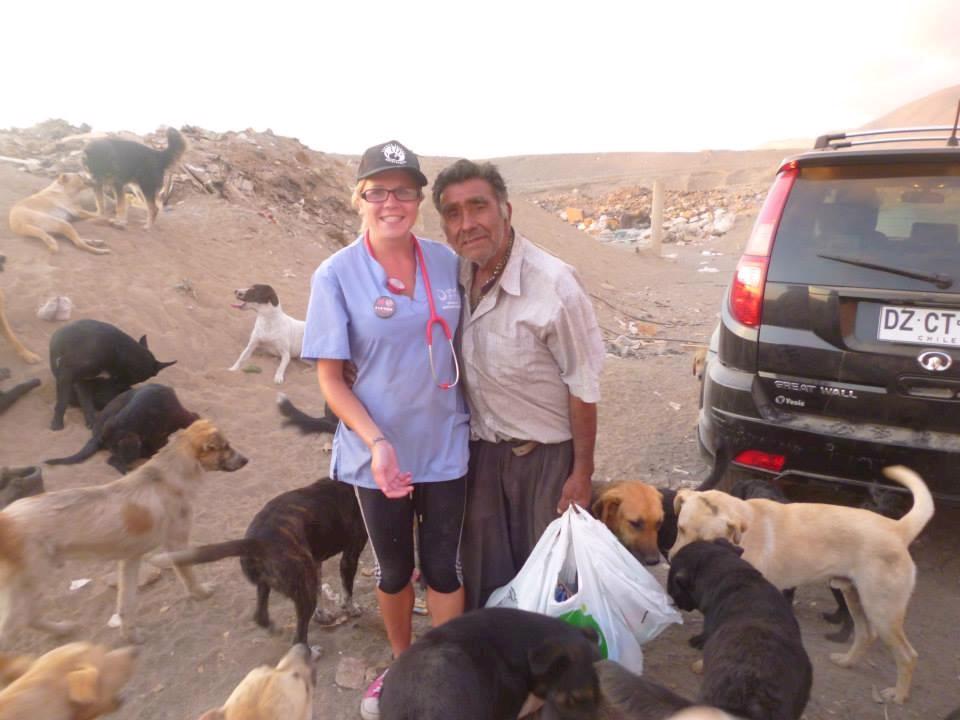
I have visited the landfills in each city. The landfills are a place where people who are sick of their animals or no longer want them come to abandon them. It is just terrible. In Antofagasta there were over 400 dogs in just that one spot of the landfill I went to. Many had mange and infected wounds. I fed all the dogs and treated for mange and parasites and cleaned the wounds. At this particular landfill was a little old man who had no money and lived in a tiny shack, his name is El Don Fernando, he had such an impact on me. He never went to school so cannot read or write and must be about 70 years old. Even though he has nothing he looks after the abandoned dogs and gives them love (he cannot afford food so a local group bring dog food every Sunday to him). Amongst the hundreds of dogs I spotted 2 little poodles, they were filthy and their eyes had no hope. Don Fernando told me that one week earlier a woman threw these 2 dogs out of her car window and drove off. The landfill is bad enough for the large dogs there but for 2 young tiny poodles there is no way they would survive, one already had a bad bite wound on his leg so the next day I decided I would go back to the landfill to get these 2 poodles. That night I thought a lot about the Don Fernando so when I woke I went by bicycle to the super market and got as much healthy and tinned food as I could carry to give to him and I wrote him a note to tell him that his kindness had inspired me. When I got to the landfill to get the poodles and I gave him the food he cried, it was very emotional.
I tried desperately to try to find them a home in Antofagasta but nobody would take them so I made the decision to fly them back to Santiago with me, where they are now staying temporarily at a friend’s. I have tried the last month to find someone to adopt these dogs, but NO BODY in Santiago will take them. There is a stigma around ´street dogs´ so people with money generally only buy dogs, and those that volunteer with animals already have houses with 50 dogs in them. SO I have made the decision to bring them back to New Zealand, I have given them every required vaccination etc and in 6 months time they will be tested to show they are free from rabies and will be eligible to enter NZ. It is a long, hard and expensive process but these dogs deserve a better life, I only wish I could bring every dog from that landfill home.
I was born with a terminal genetic condition called Cystic Fibrosis, which makes a trip like this a bit tricky for me but nothing is going to stop me from helping the animals.
Throughout this trip I have met some INCREDIBLE people. People with nothing that give their lives to try and help the animals of Chile. These people have opened their homes and have let me stay with their families, I have been so fortunate and am so grateful for the kindness that these people have shown me. It has truly been a once in a life time trip and had motivated me even more to help change the situation of Chile. I really feel like this trip has made a difference, but there is so much more work that I want to do here.
Your donation will help me buy animal food, medical equipment and treatment, pay vet bills and sterilize cats and dogs.
xoxo
NICOLE DORIGUZZI
https://www.facebook.com/nicole.doriguzzi.7
Please contact me for more information
Nicole Doriguzzi's involvement (page creator)
For 3 months I traveled Chile to volunteer with local organisations helping animals. In October 2015 I will return to Chile with my friend Graham to help more!
Other page links
Latest update
THANK YOU!! 24 November 2015
Hello
I wanted to send you a quick email to thank you for your donation on my givealittle page to help the dogs of Chile and to let you know how the trip went! I arrived back in NZ on Saturday after travelling for just over a month around Chile helping the street animals. As you probably know, I spent 3 months earlier this year volunteering in Chile with a focus on sterilization, providing medication care, donating food, educating about responsible ownership and sterilization and generating media attention to promote animal welfare.
Volunteering as a Veterinary Nurse in Chile, I knew that I was going to see a lot of abuse and neglect but nothing can really prepare you for it. There are OVER 3 million street dogs in Chile and from what I have experienced I think the number of street dogs and the neglect are a reflection of a culture which sees the dogs as a cultural norm, poverty, little to no support from the government to help the situation, no real media attention and no education to teach people about how to care for animals or why sterilization is important.
In every city I visited in Chile I noticed a culture which didn’t understand the importance of sterilization or responsible ownership. Because of this trend many people refuse to sterilize their animals and let them roam the streets to reproduce, then when the puppies are born they abandon them or even worse kill them. The key to addressing this is EDUCATION! Children in schools should be taught about animal ownership and there should be campaigns on every television channel explaining the importance of sterilization and where they can go to have their animal sterilized for free. People need to understand that one female dog and her offspring can potentially produce 66,000 dogs in just 6 years. On my first trip to Chile we hired a community hall where a Veterinarian and I sterilized over 60 dogs and 20 cats in just one day, we worked all day until late at night in terrible unhygienic conditions. We had one set of utensils, limited needles, and only one bottle of disinfectant. There was no oxygen machine or breathing tubes but we worked with what we had, given the very limited money and resources. On my first trip this year I also met with officials in local governments (and the main government), appeared on live television, featured in over 5 newspapers and appeared live on 2 different radio networks, I worked at refuges, treated dogs on the street for mange and parasites and injuries, visited landfills, donated food and sterilized animals.
Both trips to Chile were incredible life changing experiences which I hope have helped to motivate and inspire others in Chile to help the abandoned animals. I have attached some photos from the past month and will share with you just a couple of stories from this trip (I could write a novel on all the stories from my trips!):
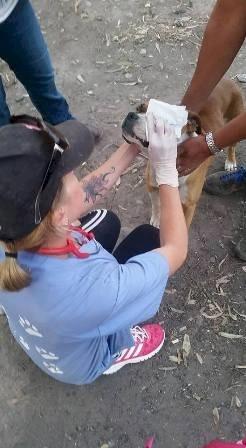
· We bought many bags of dog food to the Antofagasta rubbish dump to give to a little old man that lives in a shack in the middle of the rubbish tip. He is such a kind old man and feeds the dogs which have been dumped at the rubbish tip despite having no money. A few days earlier he had found a box at the rubbish tip and opened it to find 4 puppies. He took the puppies into his shack and saved them from certain death. We took the puppies to my friend’s house where they will be looked after, sterilized and hopefully adopted. While at the rubbish tip we treated the dogs for tics, mange and parasites and cleaned any open wounds that the dogs had. Every week new dogs are dumped at this rubbish tip, many still wearing their collars. Despite the local council funding a sterilization clinic in Antofagasta (if only more cities had sterilization clinics), there are many street dogs and some absolutely horrific cases of abuse in this city.
· I went to one of the poorest suburbs in Antofagasta and walked up and down the streets treating the street dogs for injuries, mange and tics and feeding them. On one street I saw some people gathered around a semi-lifeless dog. I ran over and told them I was a vet nurse and they explained over 24 hours ago this dog had been hit by a car. They had not moved the dog or sought any help so it had been in the incredibly hot desert sun slowing dying for over a day. I picked up the dog in my arms and moved him into the shade, he was too far gone to be saved so I sat with him and stroked him until he passed away 20 minutes later. The locals on this street had no money to get a vet and there is no SPCA organisation which could help them so this is a very common sight in Chile. After I had organised a family to bury the dog, people came up to me and asked me to check their own animals for different ailments. This was something I found everywhere I went, when locals found out I was a vet nurse and had animal medicine they all wanted me assess the animals in their homes and they would tell me about injured street animals they had seen that needed help.
· Just out of Santiago I met an amazing old woman who has a small area of land in the hills. She lives in the village about 20 minutes away but she has built a makeshift dog refuge on her patch of land. In her home she has 30 dogs and at this refuge there are over 80 street dogs that she has rescued and sterilized. This woman has no vehicle and relies on donations of food. On the street outside her small home there was a mother dog with puppies, she told me that the mother had 10 puppies but 6 had been run over and only 4 remained. She wanted to take them to her refuge when they were born on the street but no one would give her a ride. We used our rental car (a tiny Suzuki Alto) and we fit 4 people, the mother dog and her remaining 4 puppies and we drove them to Sonia’s refuge. To get to her refuge you have to go off roading up a big hill, there was one point where I really thought the little Suzuki wasn’t going to make it. We bought lots of food for this refuge and we returned a few weeks later with the rental car to help Sonia bring 4 sterilized street dogs to her refuge and to help her clean, feed, medicate and vaccinate all the animals. Some of the make shift kennels are falling apart so we also tried to fix them with wire and corrugated iron pieces but with no metal cutters, hammers or tools it was very difficult. She was very grateful to the people of NZ when I told her about the donations which allowed me to give her food and treat her animals. Luckily I managed to clean the rental car enough to not get charged a soilage fee when we returned it at the end.
· In Santiago we went to a woman’s small house where she has 73 street dogs living in it. Her back patio is split into 3 runs and every room of her house has dogs. This woman takes in the elderly street dogs which would be killed and the street dogs which are sick. We brought her a lot of food and donated money and spent the entire day cleaning the dogs and health checking every single one. Some needed antibiotics and mange treatment so I was able to treat them. This woman was so thankful that she cried after I gave her the food and donation. After this we had to take the metro to my friend’s house for dinner but on the way we were stopped by locals and asked to go to a village of shacks to treat the sick animals there. The dogs on the street here were covered in tics (which we treated) and many locals asked me into their homes to treat their own animals. They were all so grateful and they all hugged me and shook my hand.
· I was wearing my scrub top and stethoscope and treating dogs in a poor part of Santiago when a man asked me to come into his shack to check his animals. I was a little bit worried but went in anyway. Inside this shack there were many puppies and kittens everywhere. The floor of the shack was covered in excrement and rubbish and there was no running water. Most of the kittens were sick and had terrible conjunctivitis and the puppies were riddled with tics and 1 had distemper. I gave the kittens antibiotics and cleaned the pus out of their eyes and gave eye drops and treated for tics and parasites. The man explained he had tried to save them from the street where they would have died, he took them all into his shack but without money or medicine all he could do was feed them his leftover food. This is a common occurrence in Chile where people try to help by taking in many animals off the street but they are unable to care for them. For the next week I walked to his shack every day to clean the kittens’ eyes and I contacted a friend to try and find a foster home for the puppies and kittens. On the day I left for NZ I came by for the last time to treat them and showed him how to clean the eyes and gave him more food. He gave me a big hug to say thank you. I have asked a friend in Santiago to call the man to check on them and she is going to try and find a house for them. It is very hard in Chile because there is often no where you can take the animals to unless you can find someone that is willing to foster them.
· On my first trip to Chile I met an incredible woman from Wellington. She is a Sister of Mercy based in Santiago. She volunteers as a community health nurse and has established a rehabilitation centre in a very poor suburb. She has over 10 street dogs and she helps the street animals. She sells her baking to allow her to sterilize street animals and she rescues animals that have been neglected, hit by cars etc. She has no transport so uses busses and subways to take puppies to adoption drives. She is such an amazing woman and I was so happy to be able to visit her again to bring her dog food and a donation from the people of NZ. She asked that I pass on her sincere thanks to everyone that donated.
Those are just a few of the nicer stories that I can share with you, other stories I have about the animal neglect are too traumatic for some people. I meant for this to be a short email but I have got a bit carried away with writing, I will leave you with a funny story from our trip. As we were on a very tight budget we had to sleep in a tent for parts of the trip. In one city we pitched our tent at the back of a petrol station on a small patch of grass. This decision cost us our tent....... or to be more accurate my brother’s Kathmandu tent that I had borrowed from him without asking…….Our sleep in the tent started wondrously but at 3 am it took a turn for the worst. I awoke to what I thought was rain, about 30 seconds later when the smell of human excrement filled my nostrils I realized it was definitely not rain. Unbeknownst to us the automatic sprinkler system for the grass was connected to the septic tank of the public toilets and the water being sprayed was actually ammonia and human poo. Between my dry retches I managed to scream to wake my friend; now the sprinkling was a down pour of shart on the tent. The smell in the tent was so bad now that my screams were now a maniacal ‘oh my God’ and the dry retches had turned to actual vomit. We were trapped in the tent because if we opened the door we would have been sprayed with the sewerage. We had to sit in this ammonia filled tent (now also full with my vomit) until 8 am. When we were able to escape we assessed the damage to the tent, we were both in agreement that the tent could not be saved so we left it still pitched at the back of the petrol station and left feeling very sorry for ourselves. Now I can see the funny side of this and I wonder if the tent is still pitched there!!!
Unfortunately a few days before we were due to come home our rental car was broken into while we were treating street animals in Valparaiso and both our packs were stolen. Luckily we had our passports and wallets on us but my bag had all my medications for Cystic Fibrosis and Graham’s pack had the gifts for his 9 year old daughter we had collected in each city and we lost all our clean underwear!!! It was a bit of a challenge surviving with one set of clothes but luckily a friend gave me an asthma inhaler and prednisone for my breathing and we were able to buy some small gifts for Graham’s daughter on the way to the airport on the last day. Good thing this happened at the end of the trip, and on a positive note it meant we didn’t have to walk carrying heavy packs anymore!
Throughout this trip I have met the most INCREDIBLE people. People with so little that give their lives to try and help the animals of Chile. It has truly been a once in a life time trip and had motivated me even more to help change the situation of Chile. I will definitely be returning to Chile in the future to help more. If you or anyone you know is interested in helping in Chile (vets, vet nurses, builders etc) please let me know!!! If you would like to find out more about the dogs of Chile or see more photos I would love to talk to you, or you can add me on facebook to see more photos of my trip. https://www.facebook.com/nicole.doriguzzi.7
Another way you can help is through writing to the Chilean government about what you think of the situation in their country: http://www.gob.cl/escribenos/
xoxo
NICOLE DORIGUZZI

Latest donations


Who's involved?
Page Q&A
Ask a question hereAny concerns?
Report this pageThank the donor
Your message will be displayed on the page and emailed to the donor.
Your new message will also be emailed to the donor.
Saving a blank entry will delete the current comment.