
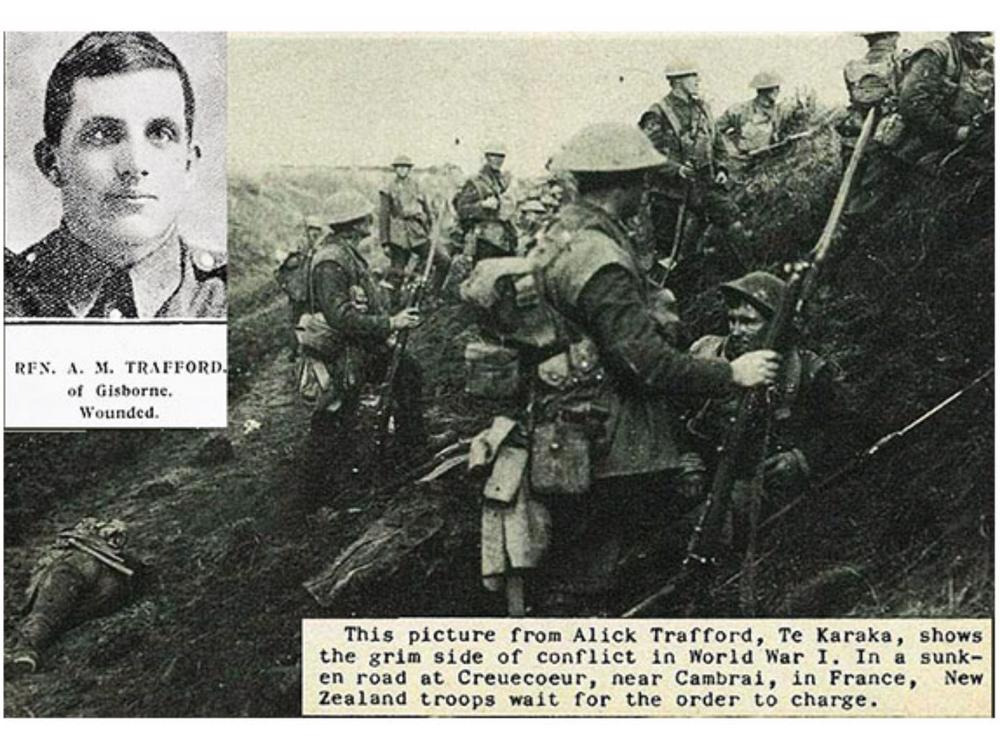
ANZAC, Alick Trafford's Emotional and Honest WW1 Diaries.
An anti-war, war book following an ordinary ANZAC boy from Gisborne. The personal, raw side of the story with little glory. A NZ treasure.
Nationwide
In May, 2018, I began writing Alick Trafford's harrowing and detailed WW1 story. It began as a family history, but the more I wrote the more I realised his story of raw truth, both in the trenches and in "civilian" life, is dear to the psyche and hearts of Kiwis. It is one of the most honest retellings of the war and its effects I have seen.
As I have written in my foreword, "With a head full of thoughts pursuing him into retirement, Alick Trafford bid his son Harvey to climb into the ceiling cavity of his house in Te Karaka, near Gisborne, find a secret package and burn it. Wrapped in army waterproof cloth were his very personal World War One diaries. His only words; 'They are dynamite'."
Alick is my paternal grandfather. I rarely spoke to him as a child and now I speak his voice as if it were mine. I sense and feel his every nuance and word...".
I now realise he suffered from PTSD (shell shock) for most, if not all of his life.
No subject is sacred - absolute fear, relentless hardship, death, grief and, surprisingly, love. Alick was mostly with the NZ Rifle Brigade. He did what he had to do, but very quickly formed a loathing for war. Although he was cited for a commission, day by day he calls upon all of his instincts to simply survive, for the sake of his mother. He tells the truth of what "the boys" really endured. He was in France and Belgium - Messines, Passchendaele, Armentieres and the liberation of Le Quesnoy town. Mates dropped dead right beside him. The war on the Western Front lasted for years and for sheer horror over a long period, it was worse than Gallipoli. This story stirs the same emotions as ANZAC day. It is no pro-war story.
For me, Alick's story answers the question why many of our ANZAC grandfathers and great grandfathers were grumpy men and difficult to live with. Just one of his many trials would have toppled me. Like all WW1 soldiers, he constantly endured one after another. Post-war, these things were bottled up, never to be mentioned again.
Below is an excerpt from my first draft:
©Ian Trafford 2019
"16 October, 1917. The rain starts again. We get the bad news our platoon is going to the front line, with 15 platoon in support a hundred yards to our rear. I have drawn a short straw.
We find our new front line shell hole homes. They are a shallow two foot deep. We are in a nervy position. In front of us, looming as the great giant is Passchendaele. A hill that has cost us many lives.
Hundreds of unburied corpses are spread all about, many floating in flooded craters, trapped in mud, or blown into unrecognisable pieces. The bones of dead men show clearly, picked over by rats and washed white by the rain. This time it appears we have not had the time to bury our own.
Not a sign of nature remains. Every tree lies uprooted by shellfire.
During the night old Fritz opened up in reality, walloping in his 5.9 whizz bangs. His range is right on us. I cannot imagine anyone will be left alive by the morning. It is solid on the nerves. My ears have gone. I have never been subjected to such direct shellfire. I have the wind up.
I am still alive in the morning. I do not know how. I had some of the closest shaves of my life. We cannot move in the daylight. Every slight movement and over they come again. The enemy aeroplanes have absolute dominance.
Showers of rain keep us cold, wet through and plastered with mud. My feet are wet and sore. We are running short of rations. We cannot safely stand up for more than a few seconds.
The day passes slowly with the thought of another night in our minds. In such an exposed position we take heavy losses. I am much in need of our two rum rations. It warms a man up.
In the night it rained and blew while old Fritz shelled us heavily. At some stage a 5.9 comes in right on target, without warning. Our earth home explodes around us. I am suddenly suffocating under the heavy pressure of mud, completely buried by the blast. I think my time has come in a last struggle to push out of this tomb. My thrashing around gets my head out and I scrape the mud off my face for a breath of air.
I have come off best of all. I set to with my spade. We drag two shocked men out alive. The third man, poor Evans, is limp, killed by the percussion. I buried him alongside.
Early the next evening we hear the joyful noise of men ploughing through mud. The 17th Ruahines arrive to relieve us. Only a dozen men of my platoon are left.
Wet to the skin and as weak as kittens from no food we pull ourselves out through the bog. We are on our stomachs negotiating the wire entanglements and shell holes, careful in our condition not to silently sink under and drown unnoticed . We are all angry and snappish at our futile trench occupation. Nobody is speaking." ©Ian Trafford 2019
Although I have published stories for school reading programmes, via Learning Media, for the School Journal and a hiking guide book, this much bigger project has really hooked me and turned into a massive undertaking. I have put 100,000 words on paper. I now have a first draft in need of another four or so months editing, researching and rewriting to perfection.
I work as a casual hiking guide in the summer season and, when there is an opportunity, photograph for the Adventure Tourism industry in Abel Tasman National Park, right near my small town of Marahau. During winter the tourists leave, the restaurants close and work is very limited. I have decided to take the gamble and keep writing. To date, I have spent my summer savings as I continue to write and write and write.
New Zealand museum and library visits will also be needed to search collections for further details and photographs.
My long term partner of seven years lives in Austria, Europe. We only see each other for three month stints in each others countries during our native winters. Her house in a small village is the perfect spot to write. Ironically, living in Austria for a few months is cheaper for me than NZ. I am grateful that later this winter she will buy me a plane ticket. From here, I feel an emotional 'tour of duty' to northern France and its cemeteries is needed to establish the final feelings and scenes of the book. (I live frugally in Austria, just as I would in NZ. I state this as I would like people to know, unlike recent publicity regarding Instagram influencers, any money donated will not be going towards a holiday!)
With such a specific book and no track record writing novel sized books, it is quite likely I will need to self publish. In the meantime I will also try to find an interested publisher. If this page is spread far and wide, there is the long shot a publisher may find me.
I have reached the uncomfortable conclusion I don't have the means to continue and require something of an income. I am dearly hoping enough people see my project as a national treasure rather than the whim of one man. Thank you.
Use of funds
Proofreader and editor. Printing drafts, travel to National Library, Spartan living expenses while I full time write, train ticket from Austria to the French Belgian border. If self-publishing; graphic designer, cover illustrator and printing.
Latest update
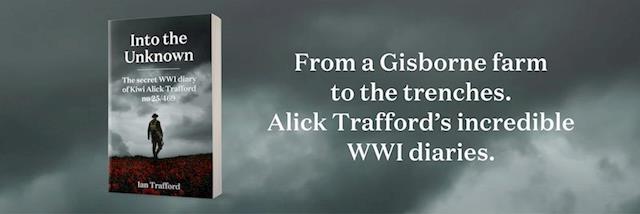
Alick Trafford WW1 Memoir Completed and Published. 4 August 2020
Hello to all of you who generously donated to my book project all that time ago. Thanks again. You will be happy to hear the book is now on the shelves. We did it.
Cheers,
Ian Trafford
https://www.penguin.co.nz/books/into-the-unknown-9780143775126

Latest donations


Who's involved?
Page Q&A
Ask a question hereAny concerns?
Report this pageThank the donor
Your message will be displayed on the page and emailed to the donor.
Your new message will also be emailed to the donor.
Saving a blank entry will delete the current comment.